
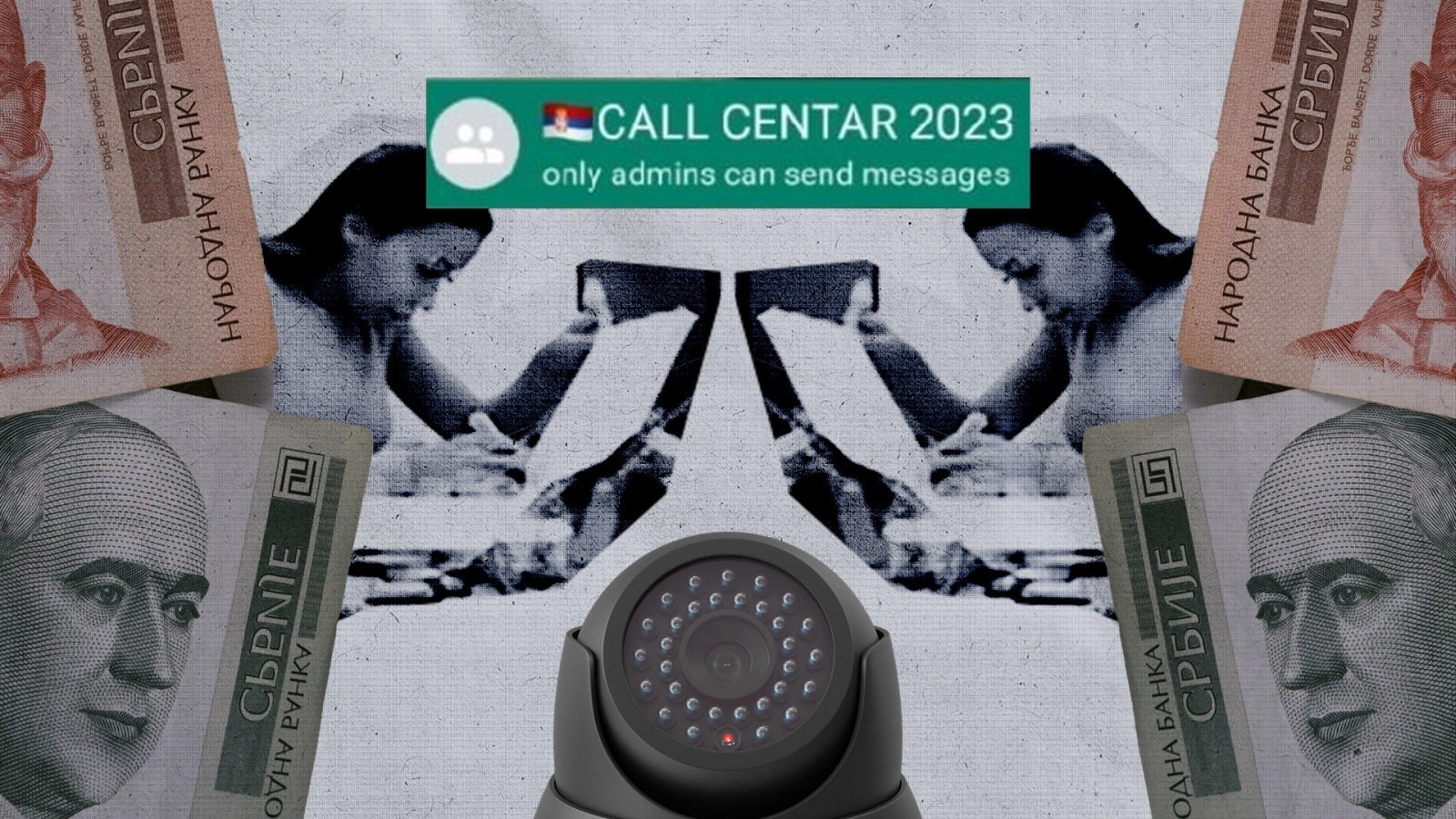
After CINS revealed how the SNS call center operated and pointed to possible vote-buying and misuse of citizens’ personal data, opposition parliamentary candidates at the time, Jelena Jerinić and Đorđe Pavićević, filed a criminal complaint against those suspected of being responsible.
Nearly three years later, nothing has happened in the case.
In December 2023, the First Basic Public Prosecutor’s Office in Belgrade ordered the police to gather information about the SNS call center case, but the police failed to do so even after three reminders from the prosecution.
“So far, no person has been interviewed as a citizen as part of the MUP’s checks,” the First Basic Public Prosecutor’s Office told CINS in late August.
On July 8 this year, the police merely informed the prosecution that the case had been transferred from the Department for Combating Economic Crime to the MUP’s Department for Combating Corruption, according to the First Basic Public Prosecutor’s Office’s response.
The MUP told CINS that, once the checks are completed, it will submit a report to the First Basic Public Prosecutor’s Office for further consideration and action.
Lawyer and former deputy prosecutor Vladimir Tupanjac told CINS that transferring the case from one department to another could indicate that the police suspect a criminal offense related to corruption was committed.
However, Tupanjac says it remains unclear what led the police to reach that conclusion.
“If the police have not interviewed anyone as a suspect or as a citizen for nearly three years, the question is on what basis they concluded that the case should be taken over specifically by the Department for Combating Corruption.”
Experts we spoke to said that the prosecution and the MUP are obstructing the proceedings in the SNS call center case, pointing to a series of problems in the way the institutions have handled the case over the past several years.
Siniša Janković, a retired police inspector, said the MUP could have forwarded the request to gather information to another department, but that the problem was that the case had been left sitting in a drawer for three years.
“The failure of MUP officials to act points to the criminal offense of abuse of office because they failed to take the necessary steps in a timely manner.”
Under the Criminal Procedure Code, the prosecution did not have to wait for the police all this time.
The prosecution could have gathered information from citizens itself, obtained documents from companies, or requested disciplinary proceedings against police officers who failed to act on its request, Tupanjac explained:
“Based on the actions taken so far, one could conclude that the police and the prosecution are accomplices in concealing a criminal offense. The police because they have failed to obtain the requested information for nearly three years, and the prosecution because it has not used all the legal mechanisms at its disposal.”
CINS’s investigation into the SNS call center documented, among other things, that a condition for working there was voting for the SNS in the upcoming elections and photographing the ballot paper, while workers were paid their fees in cash.
Nemanja Nenadić, program director of Transparency Serbia, said this was one of the best-documented cases of violations of campaign finance rules and that the proceedings should have been handled urgently.
“A procedure that was supposed to be handled urgently has been dragged out for so long that, apparently, we will reach the next parliamentary elections without any resolution.”
Nenadić places responsibility on the prosecution’s handling of the case.
“The public prosecutor is the one who should direct the investigation and determine what information the police should collect and from whom, but also take action if the police fail to do so.”

Proceedings Could Be Transferred to the Higher Public Prosecutor’s Office
The SNS call center case could be transferred from the First Basic Public Prosecutor’s Office to the Higher Public Prosecutor’s Office in Belgrade, Vladimir Tupanjac told CINS.
This could happen if the MUP’s Department for Combating Corruption, which has now taken over the case, determines that there are grounds to suspect a criminal offense falling under the jurisdiction of the Special Department for Combating Corruption of the Higher Public Prosecutor’s Office in Belgrade.
However, the Higher Public Prosecutor’s Office has already dealt with the complaint, after the First Basic Public Prosecutor’s Office previously forwarded it over suspicions of bribery and accepting bribes in connection with voting.
In early 2024, the Higher Public Prosecutor’s Office returned the complaint to the First Basic Public Prosecutor’s Office.
It told CINS at the time that the reason was that neither the First Basic Public Prosecutor’s Office nor the complainants had provided evidence that the criminal offense had been committed.
Tupanjac told CINS at the time that the footage published by CINS, along with other information from its investigation, was sufficient for the prosecution to examine the allegations and gather additional evidence.
“The Higher Public Prosecutor’s Office’s failure to act on this criminal complaint and its disregard for publicly available information creates the impression among the public that our institutions are captured and that prosecutors are shifting responsibility among themselves,” Tupanjac told CINS at the time.
After the Higher Public Prosecutor’s Office returned the complaint to the First Basic Public Prosecutor’s Office, the latter asked the police to gather the necessary information. That request, however, remained without results for nearly three years.

From CINS Investigation to a Stalled Case
The complaint filed by Jelena Jerinić and Đorđe Pavićević included, among other allegations, suspicions of the unauthorized collection of personal data, violation of equality, failure to pay withholding tax, and giving and receiving bribes in connection with voting.
The complaint was prompted by a CINS investigation into the SNS call center, published in November 2023. At the time, a CINS journalist went undercover at an SNS call center that called citizens every day to assess their support for the ruling party. In the investigation subsequently published by CINS, a recording captured a conversation in which the journalist was told that, as a condition for the job, she had to vote for the SNS and photograph her ballot as proof. The investigation also revealed that workers were paid their fees in cash.
The organization of workers at the call center was handled by the hostess agency M&J Lady, while their fees were paid out at the premises of the NGO Center for Education and Development of Youth of Belgrade (CEROB).
In addition to the criminal complaint, Transparency Serbia filed a complaint with the Agency for the Prevention of Corruption over the call center case.
In its response to the Agency, the SNS denied organizing and financing the call center, while M&J Lady and CEROB also denied any connection to its operation. CINS, however, published recordings and other findings indicating their involvement.
The case was subsequently also mentioned in ODIHR’s final report on the elections in Serbia. ODIHR cited CINS’s investigation in the context of unsolicited calls to citizens, pressure on voters, and concerns over third-party campaign financing.
Thank you for sharing CINS’s articles! Please make sure to credit the Center for Investigative Journalism of Serbia and include a link to the article you are sharing.
For more information, visit: https://www.cins.rs/en/terms-of-use/

What do you think