
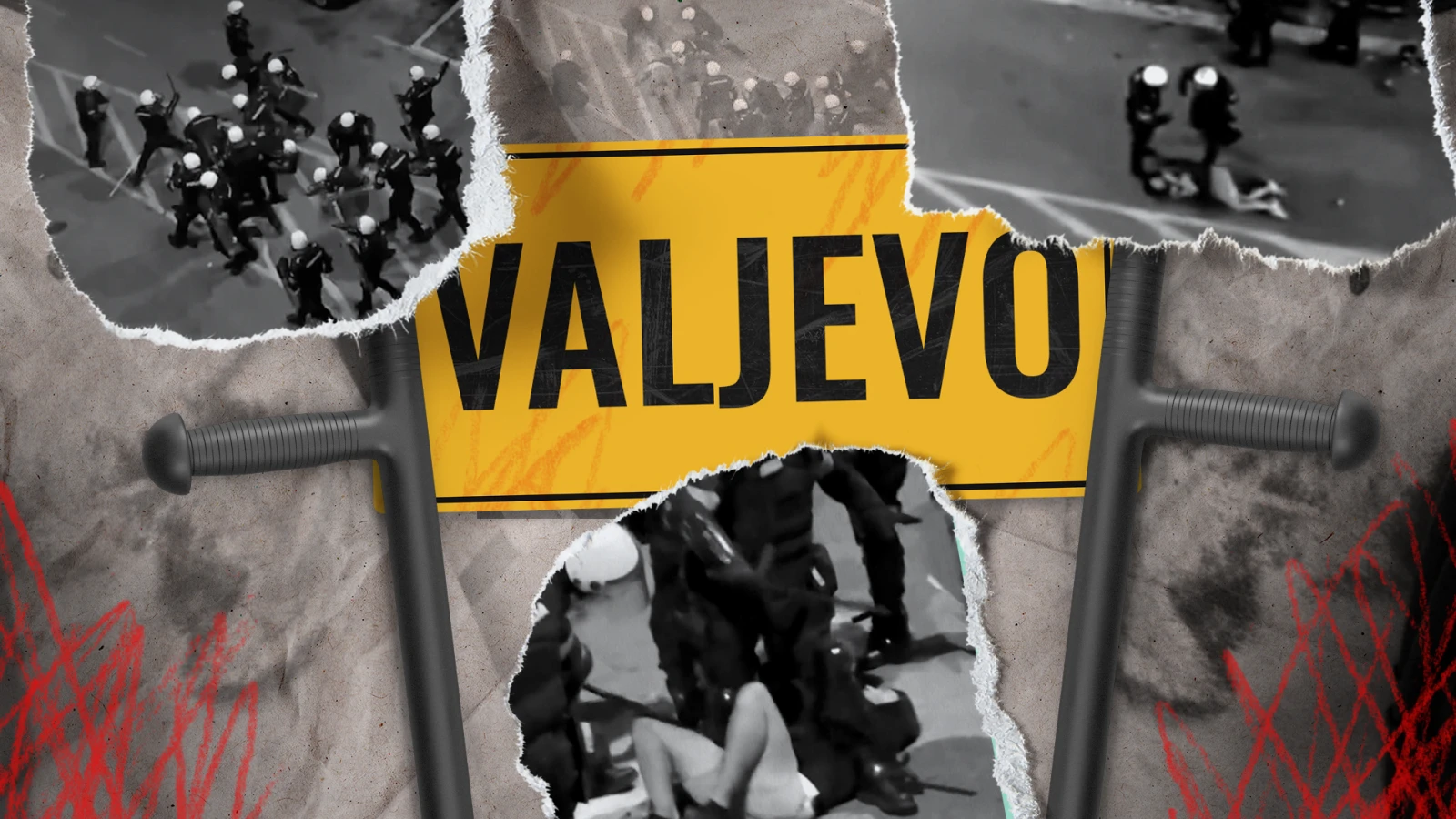
Vladimir Đorđević, a student from Valjevo, says he will remember the August 14 protest in that city for the rest of his life.
He took to the streets to support a fellow citizen whose café had been vandalized the day before, but the peaceful protest, he says, suddenly turned violent.
There was tear gas in the streets, and at one point, the police began pushing back the crowd. Vladimir recalls moving into an alleyway to rinse his eyes when he noticed police officers chasing after someone.
“At that moment, I’m thinking: if I start running, they’ll catch me within five meters and beat the hell out of me. They’ll say, ‘Why were you running if you didn’t do anything?’ And since I hadn’t done anything, I just stood there, so it wouldn’t look like I was fleeing for no reason.”
The police officers eventually reached him, Vladimir explained to CINS.
“Two of them started beating me, and then two more joined in. They knocked me to the ground and kicked me.”
Vladimir is not alone. Numerous videos on social media and in the news show police beating citizens lying on the ground, often with multiple officers targeting a single protester.
And it is not just the videos. Bone fractures, contusions, hematomas, kicks to the head, and blows with stones were documented in a forensic medicine specialist’s report published by BIRN.
Beaten citizens and those detained at the station after the protest – 27 of them, including Vladimir – have filed criminal complaints against the police officers and the Chief of the Valjevo Police Department.
Yet, while evidence of excessive use of force by police that night continues to surface publicly, institutions are still failing to prosecute those responsible.
CINS’s investigation reveals that the oversight note by the Ombudsman, who conducted a review of the police conduct in Valjevo, states that he “found no irregularities or illegalities” in the actions of the police.
He reached this conclusion based on police documentation and interviews with the Valjevo Police Chief, despite the public availability of videos and testimonies from citizens who were brought to the police station with injuries.
Ombudsman Zoran Pašalić told CINS that he can’t finish the procedure because he hasn’t spoken to those detained that night.
However, their lawyers claim that no one has contacted them. Sanja Radivojević, a lawyer from the Belgrade Centre for Human Rights (BCHR), says that such interviews are not even necessary for a final judgment given the existence of published video footage.
“If he established these findings early in the procedure, specifically during the direct oversight visit itself, it is unlikely that this stance could be changed down the line.”
The Ombudsman’s Oversight in Valjevo
Ombudsman Zoran Pašalić conducted an oversight visit to the Valjevo police five days after the protest, on August 20. He was received there by Vladan Jerinić, the chief of the Valjevo Police Directorate. Jerinić told the Ombudsman at the time that police officers had used coercive measures during the protest that night in accordance with the law – specifically, “in situations where they were exposed to attacks by gathered citizens and when there was no other way to restore public order and peace.”
The videos that flooded social media that same night paint a different picture. One of them, for instance, shows a situation where at least six police officers beat a young man who is lying on the ground and offering no resistance. This is supported by BIRN’s findings based on an evaluation by a forensic medicine specialist, which notes, among other things, that multiple officers beat a minor on the head and body even though he had previously raised his hands and said, “I am a minor, I didn’t do anything wrong.”
According to the oversight note obtained by CINS, there is no indication that Pašalić spoke with the police officers who were out on the streets of Valjevo that evening. It states that he only reviewed documentation.
Radivojević explains that interviewing each officer individually is crucial because the reports on the use of coercive measures – which the Ombudsman also reviewed – are written by the officers themselves, while the final evaluation is given by their police supervisor.
For that reason, she adds, it is difficult to talk about an independent and objective review of the use of force.
“It is particularly problematic that the same commander could, in certain instances, have issued the order to use force himself. This raises serious questions about conflicts of interest and the actual impartiality of the oversight.”
Upon reviewing the police documentation from that night, the Ombudsman found no illegalities or irregularities on which to base recommendations to the Valjevo Police Directorate, the note concludes.
During Pašalić’s oversight visit, there were no citizens being held in the police premises. The situation was the same the day before, August 19, Pašalić told CINS, when a colleague from his office visited the police station.
Radivojević points out that Pašalić went too late – five days had passed – while Miloš Janković, a former Deputy Ombudsman, adds that in cases like this, the reaction must be swift and immediately after learning about the event.
Attorney Jana Aćimović has told CINS that in the days following the protest, when both the Ombudsman and his colleague were visiting the Valjevo Police Station, many citizens who had been beaten at the protest were giving statements to the police in the presence of their lawyers. She herself was there with her client during those days.
“This means that if he [the Ombudsman] was also there during those days, they could have informed him that hearings were currently taking place, provided he actually wanted to establish contact. It is a small police directorate.”
Pašalić, however, has told CINS that he had no information about this and that the focus was on the arrest of citizens and their treatment during the period in which they were detained.
“No one contacted us. We informed everyone that if they encountered any issues, especially since no one was present in the detention facilities, they should reach out to us and we would determine the appropriate course of action.”
Four lawyers contacted by CINS, who are part of the legal team representing the injured citizens, state that neither they nor their clients received any invitation from the Ombudsman.
Pašalić claims that his office contacted them directly or indirectly through their lawyers, but asserts that no one responded. That is precisely why, he explains, the case remains open and is awaiting a final decision.
Radivojević from the BCHR, however, explains that the Ombudsman must act regardless of whether citizens have filed a direct complaint.
She states that the videos capturing the unlawful conduct of the police were published in the media and were already sufficient for the Ombudsman to establish the identity of those responsible and conduct individual interviews with them.
“Simply by conducting individual interviews with the police officers who acted against citizens in Valjevo that evening, he could have formed his own impression on whether their statements matched the details entered into the reports on the use of force. Even without additional evidence, that can be enough for the Ombudsman to form a position on whether a violation of rights occurred,” Radivojević says.
A Nine-Month Investigation
By law, the Ombudsman is required to complete their inquiry within 90 days, a deadline that has long passed in the Valjevo case. However, the law leaves room for this deadline to be extended, though it remains vague on how long.
“This process won’t drag on for ten years, but we are giving them some time to get in touch. That could be six months or a year because our goal is to bring this case to a close,” Pašalić told CINS.
The significance of the Ombudsman’s final decision is multi-faceted, our sources point out.
Miloš Janković explains that, in practice, reports by the Ombudsman are also used as evidence in court proceedings.
“Even the Constitutional Court of the Republic of Serbia has done this, citing his findings and recommendations.”
Sanja Radivojević adds that the weight of the Ombudsman’s recommendations should not be underestimated because, for instance, they can form the basis for disciplinary proceedings against police officers.
“If an authority fails to act on a recommendation from the Ombudsman, he has the legal authority to demand an explanation for their conduct, as well as to notify Parliament, the Government, and the public.”
During the Ombudsman’s visit back in August, Valjevo Police Chief Jerinić announced that an “evaluation into the justification of the use of force would be conducted for the officers who deployed coercive measures at the Valjevo protest, based on their reports and other evidence,” the official note states.
The Ministry of Internal Affairs’ Internal Affairs Sector is currently gathering the necessary information regarding the conduct of the police at the Valjevo protest, following orders from the Basic Public Prosecutor’s Office in Valjevo, and in response to complaints filed by citizens.
The prosecution failed to provide CINS with copies of the criminal complaints, prompting us to file an appeal with the Commissioner for Information of Public Importance and Personal Data Protection.
The Commissioner’s response outlines everything the prosecutor’s office has done so far, noting, among other things, that the Commission for Evaluating the Use of Coercive Measures has gathered reports on the use of force from 36 police officers.
Sanja Radivojević also points out that Council of Europe recommendations advise that police officers suspected of committing torture against individuals should be suspended until the conclusion of proceedings.
“I am certain that officials within the Valjevo Police Directorate and the Internal Affairs Sector possess the data on exactly which police officers were deployed to act against citizens on the streets of Valjevo during those days.”
Thank you for sharing CINS’s articles! Please make sure to credit the Center for Investigative Journalism of Serbia and include a link to the article you are sharing.
For more information, visit: https://www.cins.rs/en/terms-of-use/

What do you think