
While Serbia was still grappling with the scale of the fatal accident following the canopy collapse in Novi Sad, Dragan Dingarac received an unusual request.
Dingarac is a civil engineer with experience working on major projects in Serbia, such as Belgrade Waterfront. Among other responsibilities, he and his team organize site operations – determining the required worker profiles, their experience and expertise, the headcount needed for a task, and their exact duties.
They were hired for these exact services during the construction of a section of the residential complex at the EXPO construction site. However, shortly after the canopy collapse, Dingarac – or to be precise, his company – was tasked with reviewing all documents upon which the buildings were to be constructed, even though a review of documents after the start of construction is highly unusual.
Reviewing the paperwork, they uncovered one issue after another –more than 270 errors – and pointed out flaws that, by their assessment, could have led to “fatal consequences”. Throughout his engagement, his relationship with SMB-Gradnja, the consortium member that hired him, as well as with subcontractors, grew increasingly strained, culminating just under four months later, when his contract was terminated.
Documents gathered by CINS alongside accounts from interviewed experts reveal that the magnificent project that authorities like to boast about masks works of questionable quality and plans containing calculation errors.
Radomir Folić, former dean of the Faculty of Technical Sciences and a structural engineer, reviewed the documents gathered by CINS and concluded that the construction was plagued by numerous defects in both design and execution.
“Defects are damages resulting from errors in design and execution. (…) Poor execution of works can ultimately lead to collapses and loss of human lives.”

An error that could have led to “fatal consequences”
Part of the international EXPO exhibition, which Serbia is set to host in 2027, is a residential complex of 1,500 apartments currently under construction. Just under a third of these, 460 units, were assigned to the company SMB-Gradnja, which in turn hired Dragan Dingarac’s company, Dingrakon.
The intent is for these apartments to initially accommodate exhibition participants, and then later be sold on the market – turning it into a standard residential neighborhood. A similar approach was used for the Belville neighborhood following the Universiade hosted by Serbia in 2009.
According to the construction plans, the complex consists of a series of buildings separated by a plateau featuring planter boxes, benches, and a children’s playground. An underground garage is planned beneath the plateau, meaning the plateau itself is actually a concrete slab above the garage.
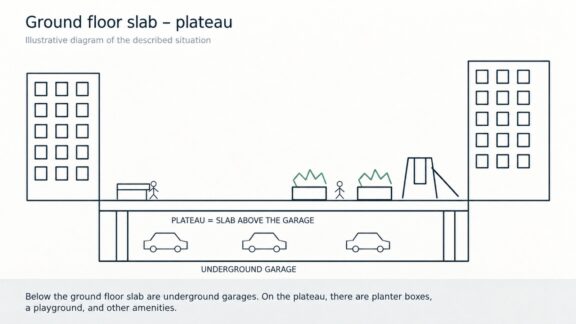
AI-generated schematic diagram
However, in the event of a fire, a fire engine would also need to cross over this plateau, which then has to be strong enough to withstand that heavy load.
CINS’s investigation reveals that this was not the case.
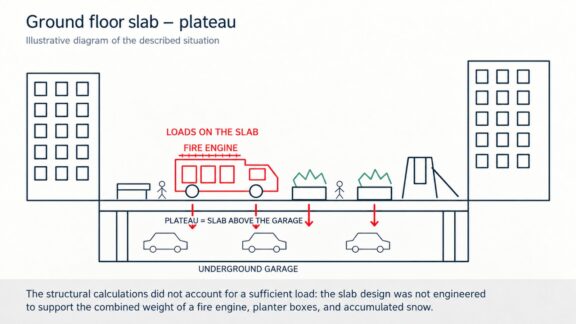
AI-generated schematic diagram
Reviewing the documents, Dragan Dingarac discovered that the structural calculations failed to account for the substantial weight generated by the layers above the slab, such as planter boxes, the accumulation of snow in winter, or a fire engine. According to his assessment, the actual load in reality is 266% higher.
Professor Folić says that given such a massively miscalculated load, the slab would have collapsed.
“That is a serious error that can lead to the complete collapse of that entire building.”
Folić emphasizes that that the issue must be fully rectified.
“First the design – checking the slab, what it rests on, the walls, columns, as well as verifying and reinforcing everything all the way down to the foundations.”
Civil engineer Edin Drljo also agrees that a collapse was possible under such a load.
“If the load is as much as 266% higher than what was designed for, there is a serious risk of significant cracking, deformation, and ultimately, structural collapse,” Drljo explains.
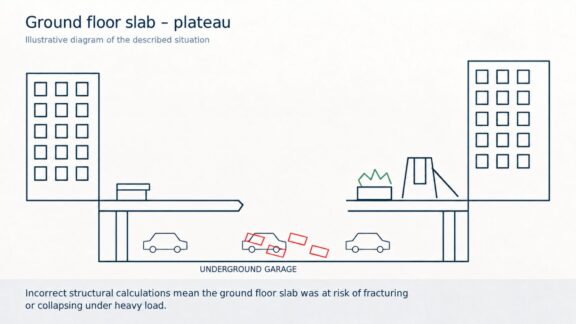
AI-generated schematic diagram
This was one of the major oversights Dingarac spotted in the Detailed Engineering Design. This specific document is not legally required to undergo technical oversight, but SMB-Gradnja asked Dingarac to perform one anyway.
What he could not have anticipated was the sheer scale of the problem.
Dingarac notified the Building Directorate of Serbia and the other companies within the consortium working on the construction of the residential complex. Consequently, the other companies checked their own building plans and found the exact same error – the calculation for the problematic ground floor slab was flawed across the board.
Ultimately, the design had to be modified for the entire complex, and the slab thickness was increased from 25 to 28 centimeters.
However, it remains unclear whether this adjustment is sufficient. In an email obtained by CINS, Dingarac notes that he isn’t convinced:
“Then again, whether this is enough reinforcement… nobody knows anymore, given the superficiality of the new load analysis they made when adopting my objections.”
Jasna Zdravković, a civil engineer from the Building Directorate who supervised the construction of the EXPO residential complex, told CINS that the slab was thickened to make it easier to install reinforcement – primarily steel bars that give concrete its strength and durability. She added that the changes were approved by an independent review board.
“Everything was reviewed by the technical oversight team, and they agreed to the modifications that were made.”
However, civil engineer Edin Drljo feels that the Building Directorate’s response was illogical. Based on Dingarac’s objections, the actual load on the slab is more than double what was originally calculated, yet its thickness was increased from 25 centimeters to just 28 centimeters.
“Increasing the slab thickness by a mere three centimeters, without additional reinforcement, does not significantly increase its load-bearing capacity.”
Professor Folić agrees that thickening the concrete does not solve the load-bearing issue.
“Let me tell you right away, the structure is unstable. (…) It needs to be recalculated, and the entire structure from the slab to the foundations must be reviewed.”
The Building Directorate did not respond to CINS’s interview request or the questions sent to them. Our journalist spoke by phone with Building Directorate engineer Jasna Zdravković, but she directed a portion of the questions to the Directorate’s official email address.
Predrag Petričević, the owner and director of SMB-Gradnja, declined to comment during a brief telephone conversation with CINS’s journalist.
“I’m sorry, but it’s inappropriate for someone to introduce themselves as a journalist and speak with me on this topic.”
Dragan Dingarac also declined to speak to CINS and refused an interview.
The Sector for Emergency Management of the Ministry of Interior reviewed the fire safety documents for the residential complex. One of the objections raised by the sector concerned the calculation of the slab above the garage, specifically that it had not been submitted alongside the rest of the documents. Papers obtained by CINS from the Ministry of Interior show that the complete documentation was only delivered a full year after Dingarac first identified the deficiencies.

Dragan Dingarac sent 270 objections to SMB-Gradnja regarding the Detailed Engineering Design. Email correspondence obtained by CINS shows that the majority of the flaws pointed out by Dingarac’s company were corrected.
In the meantime, issues remained not only within the design paperwork, but they began piling up on the construction site itself.
“The way they’re working is a disgrace”
Emails and messages exchanged between Dingarac, SMB-Gradnja, subcontractors, and the Building Directorate of Serbia reveal that there was criticism regarding the quality of workmanship, and the tension in communication became increasingly difficult to manage.
Dingarac and members of his team constantly complained about how the subcontractors were performing. One underlying cause may be that an annex to the contract between SMB-Gradnja and Dingrakon explicitly states that certain companies could not be allocated a larger volume of work as subcontractors due to previous delays and quality deficiencies.
Dingarac claims that SMB-Gradnja did not fully respect this clause of the contract. WhatsApp group messages between November and February reveal persistent issues.
MESSAGES FROM THE CONSTRUCTION SITE
In early 2025, the Building Directorate of Serbia, acting as supervisor, began sending increasingly specific warnings to SMB-Gradnja. Among other things, they pointed out frayed wall edges, inadequate concrete pouring for slabs and walls, and so-called concrete segregation on walls and columns. Segregation occurs when concrete components such as gravel and cement become separated, causing the mixture to become non-uniform. When this happens, voids form inside the concrete, which can be dangerous. Specifically, this concrete contains interlocking steel reinforcement bars – which later rust and deteriorate due to these voids.
Drljo states that segregation is the result of poorly executed work.
“The moment they see that segregation has occurred, if they continued building without remediating it or logging it as an error, it raises questions about that company’s competence.”
Professor Radomir Folić agrees.
“When there is a trend where things constantly and continuously require remediation, that is proof of a poor contractor.”
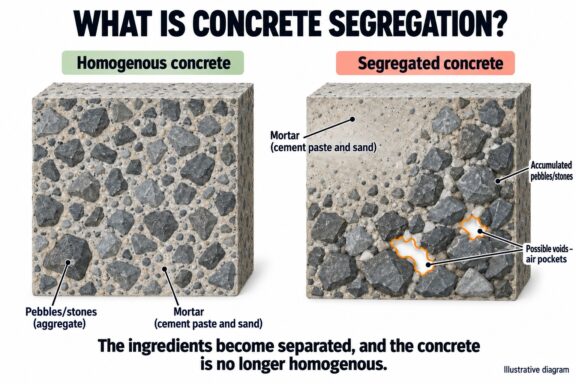
AI-generated schematic diagram
“We have a situation where concrete quality has significantly deteriorated, and urgent measures must be taken to fix it,” reads one GDS memo from February 2025.
Due to continuously poor construction quality, that very month GDS ordered the demolition of three already-constructed columns where inadequate pouring had caused severe concrete segregation.
Professor Folić explains that concrete segregation is an exceptionally major issue and that supervision is obligated to halt pouring immediately if it occurs.
Furthermore, according to Dingarac, his team drafted guidelines on how works should be executed for every major position, but these instructions were ignored.
He also pointed out that SMB-Gradnja lacked a quality control engineer and employed only a single health and safety (OHS) officer, who was not even present at the construction site every day.
Drljo explains that it is vital for an OHS officer to be on-site daily.
“The number of accidents in construction is the highest compared to all other industries. That is why safety is an absolute priority on every construction site.”
On the other hand, subcontractors complained about the manner in which Dingarac and his team communicated.
Tensions grew, as did technical issues.
In February 2025, following a verbal altercation with SMB-Gradnja’s site manager Rade Kašić, Dingarac pulled his men off the site. When he returned two days later, he found out that his contract had been terminated.
Officially, SMB-Gradnja terminated the contract due to communication issues. In an ongoing lawsuit before the Commercial Court filed by Dingarac against the company, Kašić testified that Dingarac was harsh in his communication and that he frequently had to de-escalate situations.
“Dragan entered into conflicts with consortium members at the very start of construction, so they deemed it impossible to cooperate with him.”
Claiming his contract was terminated without grounds, Dingarac is now seeking nearly 17.9 million RSD from SMB-Gradnja. This sum includes unpaid earnings for the final month, penalties for unilateral contract termination, and a completion bonus Dingarac claims they would have been entitled to if the project were completed ahead of schedule.
According to the contract, the bonus is payable if SMB-Gradnja breaches its contractual obligations – for instance, by hiring subcontractors without consulting Dingrakon – as stated, among other things, in the court documents.
The main hearing is currently underway at the Commercial Court in Belgrade, where members of SMB-Gradnja have given testimonies, while testimonies by GDS employees and subcontractor companies are expected to follow.
Thank you for sharing CINS’s articles! Please make sure to credit the Center for Investigative Journalism of Serbia and include a link to the article you are sharing.
For more information, visit: https://www.cins.rs/en/terms-of-use/

What do you think